
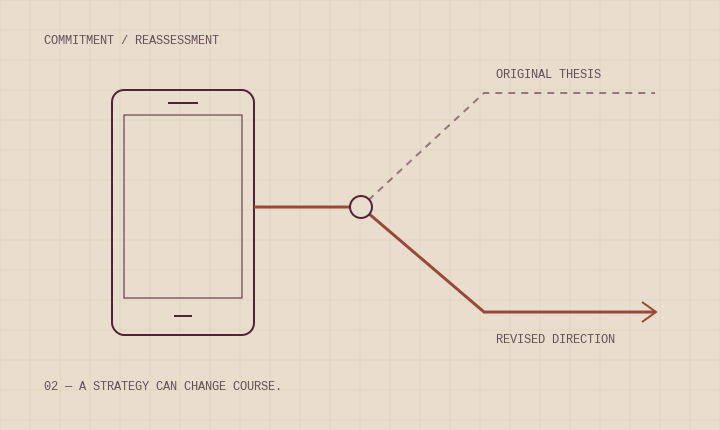
The original commitment
In September 2013, Microsoft announced terms of €3.79 billion for substantially all of Nokia's Devices & Services business and €1.65 billion for patent licensing. Steve Ballmer, then Microsoft's CEO, presented the agreement as a way to accelerate the company's phone ambitions.
The €5.44 billion headline combines a business acquisition with licensing. Treating it as a price for the entire Nokia company would misdescribe the announced transaction.
Read the record: [M1] ↗
A revised strategic premise
On July 8, 2015, Microsoft announced a phone hardware restructuring. Satya Nadella described a move away from growing a standalone phone business toward supporting a broader Windows ecosystem. The company said the revised outlook was below its original expectations and anticipated an impairment of approximately $7.6 billion.
This establishes management's stated change in direction. It does not, on its own, identify how much of the outcome came from leadership decisions, execution, competition or the surrounding platform market.
Read the record: [M2] ↗
Keep estimate and result separate
The July 21 earnings release reports a $7.5 billion non-cash impairment associated with the Nokia acquisition, alongside $780 million of restructuring charges. The impairment is an accounting reduction in asset values, not a new cash payment of that amount.
The earlier €5.44 billion consideration and later dollar impairment also have different currencies, dates and accounting bases. Dividing one by the other would not produce a meaningful percentage loss on the deal.
A checkpoint for changing course
A decision review should distinguish the original thesis from the obligation to keep defending it. Ask which assumptions were necessary, which indicators would reveal their failure and who has authority to stop allocating resources when those indicators change.
A public impairment is a late and visible accounting event. A useful operating review would examine the thesis before that event: customer adoption, developer participation, product economics and the strategic contribution of owning hardware. These are suggested questions, not metrics verified in this dossier.
Calling the entire story one person's failure compresses a sequence of commitments and revisions into a personality judgment. The archive preserves the sequence so readers can examine accountability without pretending that a press release resolves causation.
CHRONOLOGY
The document timeline
- Decision
Purchase agreement announced
Microsoft sets out the Nokia devices business purchase and patent licensing terms. [M1] ↗
- Revision
Phone strategy is reset
Microsoft announces restructuring and estimates an approximately $7.6 billion impairment. [M2] ↗
- Disclosure
Recorded charge is reported
The earnings release reports a $7.5 billion non-cash impairment. [M3] ↗
PRIMARY EVIDENCE
Read the source documents.
Publisher dates are historical document dates. This research edition was checked on 27 September 2026. Company communications establish what a company said; their explanations are not independent causal findings.
- M1Agreement to acquire Nokia's devices and services business ↗
Microsoft · 3 Sep 2013
Announced euro-denominated purchase and licensing terms; includes management's strategic case.
- M2Restructuring of the phone hardware business ↗
Microsoft · 8 Jul 2015
Planned restructuring and approximately $7.6 billion impairment estimate. Later results provide the recorded charge.
- M3Fiscal 2015 fourth-quarter earnings release ↗
Microsoft · 21 Jul 2015
Reports a $7.5 billion non-cash impairment and $780 million restructuring charge. These are different accounting categories.