
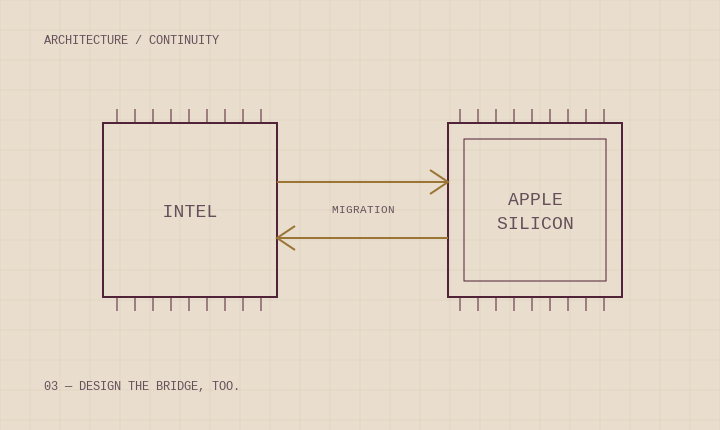
The commitment and the bridge
Apple announced the Mac's move to its own silicon in June 2020, with Tim Cook presenting the transition. The initial plan called for the first system that year and completion in about two years. Apple also described developer tools, Universal app support and Rosetta 2 translation to help software cross between architectures.
The company framed the change around performance, energy efficiency and a shared architecture across products. Those were Apple's stated goals; this dossier does not independently certify the performance claims.
Read the record: [A1] ↗
Product evidence arrives
Apple introduced M1 on November 10, 2020. Its announcement described a system on a chip integrating functions previously spread across separate components, with a unified memory architecture. That is evidence of the announced product design, not a measurement of every application's experience.
In June 2023, Apple stated that the new Mac Pro completed the Mac transition to Apple silicon. That completion announcement came nearly three years after the initial plan. Completion here refers to the Mac product lineup; it does not mean every existing customer or application had migrated.
The bridge is part of the strategy
A platform has several clocks. Hardware can change on a launch date, while developers, enterprise buyers and individual users move on different schedules. A migration mechanism gives those groups room to adopt the destination without sharing a single deadline.
When reviewing a comparable transition, ask what can run during the overlap, which capabilities require a native update and how customers can recognize the difference. Compatibility should be an explicit product promise with boundaries, rather than an assumed consequence of a new architecture.
The timeline also offers a discipline for interpreting plans. Keep the original approximate target visible beside the eventual milestone. Erasing the target makes execution look inevitable; treating an approximate target as a precise contractual deadline overstates the evidence. A good archive retains the wording and the later event.
The remaining evidence gap
This file documents the announcement sequence. It does not attribute revenue, battery-life improvements or market share to the decision. Independent workload tests, developer migration data and customer experience would be needed to assess those outcomes. Manufacturer statements are valuable primary evidence of intent and release milestones, with clear limits as performance evidence.
CHRONOLOGY
The document timeline
- Decision
Architecture transition announced
Apple outlines a move to its own silicon and a roughly two-year transition. [A1] ↗
- Milestone
M1 is introduced
Apple announces its first chip designed specifically for the Mac. [A2] ↗
- Outcome
Mac lineup transition completes
Apple identifies the new Mac Pro as completing the transition. [A3] ↗
PRIMARY EVIDENCE
Read the source documents.
Publisher dates are historical document dates. This research edition was checked on 27 September 2026. Company communications establish what a company said; their explanations are not independent causal findings.
- A1Mac transition to Apple silicon announced ↗
Apple · 22 Jun 2020
Initial timetable, developer tools and company's architectural rationale. Performance language is the manufacturer's claim.
- A2Apple unveils M1 ↗
Apple · 10 Nov 2020
First Mac-specific Apple chip announcement and integration description. No independent benchmark validation is claimed here.
- A3M2 Ultra announcement and transition completion ↗
Apple · 5 Jun 2023
Company states that the new Mac Pro completes the Mac transition. This is a product-line milestone, not universal app compatibility.